Docs Resources
Architecture
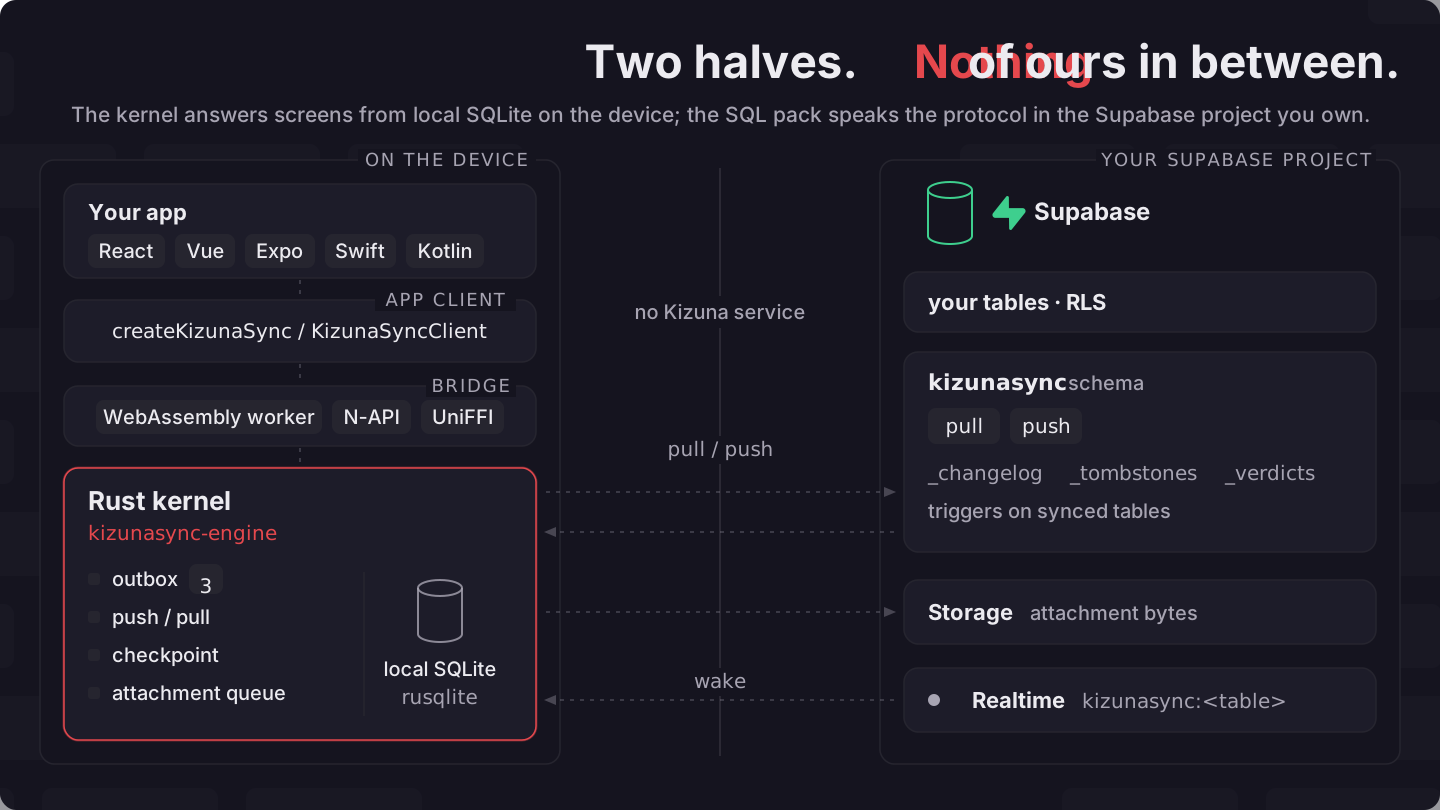
A Kizuna deployment has two halves. On the device, the engine answers screens from local SQLite. In the Supabase project you own, the SQL pack speaks the sync protocol. Nothing of Kizuna's runs between them: row sync exchanges JSON with Postgres, and attachment bytes travel through Supabase Storage on a separate channel.
flowchart LR
    App["Application API"] --> Engine["Kizuna engine"]
    Engine --> SQLite["Local SQLite"]
    Engine --> Remote["pull / push remote"]
    Remote --> SQL["Kizuna SQL pack in Supabase"]
    SQL --> Tables["Application tables under RLS"]
    Engine --> Bytes["File and transfer ports"]
    Bytes --> Storage["Supabase Storage"]
    Wakeup["Realtime wake-up hint"] --> Engine
Kernel, bridges, and app clients#
Kizuna keeps three layers distinct, and every application language sits on the same bottom one:
| Layer | What it is | Where it lives |
|---|---|---|
| Kernel | SyncEngine | crates/kizunasync-engine |
| Bridge | JSON plus a handle | crates/kizunasync-ffi (UniFFI), crates/kizunasync-napi (N-API), crates/kizunasync-wasm (browser worker) |
| App client | Typed API in the app language | createKizunaSync (JavaScript); KizunaSyncClient (Swift and Kotlin) |
One Rust kernel does the synchronization work. Swift and Kotlin ship as generated UniFFI packages over KizunaSyncEngine, and they never call selectEngine. JavaScript reaches the same kernel through a compiled N-API addon or a compiled WebAssembly worker. selectEngine lives inside the app client createKizunaSync returns, and it only chooses which of those compiled artifacts to load. It runs once, on the app client's first engine call rather than when the client is created, and it reads an engine carried by the driver first. That is how web, Vite, and Expo web all run the kernel in the browser driver's worker. Failing that, it picks UniFFI on React Native when the React Native module in kizunasync is linked. It picks N-API on Node and Bun when the addon loads. The driver names the store as databasePath, or null for a private in-memory database. In every other case that first call fails with ENGINE_UNAVAILABLE and the client keeps that failure, rather than running a second implementation, and Project status lists the lanes.
There is no Rust app client. The kernel is embedder SPI in private workspace crates (publish = false). The kizunasync CLI provisions the SQL pack rather than syncing rows, so it is not an app client either. Kernel and app clients covers the same split for application code, and Repository layout names the paths, crates, and imports.
The local store is rusqlite inside the kernel on every runtime. Swift and Kotlin are thin UniFFI hosts: they pass databasePath and a complete remote, and HTTP runs in Rust. On the JavaScript N-API path the kernel opens that same rusqlite store; HTTP is the exception, because the addon calls back into the host remote so supabase-js can attach the session.
The shared conformance corpus and conflict vectors check the one engine's behavior on each runtime that runs it. They do not stand in for platform-specific storage and lifecycle testing, which Match the test to the claim separates case by case.
The engine and its ports#
The kernel owns local queries on every runtime: a select, update, or delete sends its plan or its target filters across the bridge, and the kernel resolves rows, sort, limit, projection, and write targets there, never in the host language. The kernel also owns the outbox, push and pull orchestration, checkpoint application, rejection handling, and the attachment queue. Everything platform-specific sits behind a port the host supplies: five that do work and three that only hint. On the JavaScript host all eight are exported:
| Port | Responsibility |
|---|---|
IStoreLocator | Names the SQLite file the kernel opens, or hands over an engine the driver already runs; it can carry the loader for the engine a React Native build links, and the platform's connectivity and foreground ports |
IProtocolRemote | The pull and push row-sync calls |
IFileStore | Local attachment bytes |
ITransfer | Attachment upload, download, confirmation, and cleanup |
IEngineTransport | The call surface a driver-provided engine exposes, for the browser worker |
IWakeup | A hint that a pull may find new work |
IConnectivity | A hint about network state |
IForeground | A hint that the app became visible again |
On JavaScript those ports are how the host talks to the kernel. A locator names the database the kernel opens, or hands over an engine it already runs; the kernel owns the only connection to it, and no host code executes SQL against it. The three hints carry no data and no correctness obligation. IConnectivity can hold attempts back while the device is offline and ask for a flush on reconnection, and IForeground lets the adapter that owns the session refresh the JWT and sync when a tab or app returns to view. A driver that knows its platform's signals hands them over as platformPorts on the locator, so an app passes a connectivity or foreground port only to replace the driver's. Drivers and the TCK documents what an implementation of each port owes the engine.
On Swift and Kotlin those ports live inside the thin client, configured with databasePath, remote, and an optional attachmentRoot.
The local data path#
A local mutation changes the application row and enqueues its outbox record in one local database transaction, so a queued write and the row it produced always land together. The engine pushes queued mutations in issue order, reconciles the returned verdicts, then pulls server changes. Offline writes follows one such write from the tap to the toast.
A paginated pull stages its pages until the response closes the checkpoint boundary. Rows, tombstones, the final cursor, and the staging cleanup commit together in one local transaction. When the outbox is not empty the checkpoint commits all the same. The engine replays the pending mutations over the committed snapshot inside that same transaction, so incoming server state never replaces an unconfirmed local value. Checkpoints states the guarantee that rests on this.
Those are transaction-level properties of the engine. The repository holds no complete kill-test matrix across every driver and platform, so they are not a claim that every supported storage stack survives process or device loss mid-write.
The server data path#
The installed SQL pack owns the global change sequence, the change and tombstone ledgers, cursor and retention state, per-mutation verdict records, Hybrid Logical Clock metadata, the opt-in server-side conflict journal, attachment metadata, and the functions over them. When you provision a table, the pack also attaches change-tracking triggers to it, the same Postgres mechanism Supabase documents. Kizuna adds no columns to your rows, and it replaces none of your policies.
The authenticated SQL surface contains five public functions:
| Function | Role |
|---|---|
kizunasync.pull | Downloads row changes and tombstones |
kizunasync.push | Applies queued row mutations and returns verdicts |
kizunasync.attachment_confirm | Records integrity metadata after an object upload |
kizunasync.attachment_metadata | Returns integrity metadata a peer can already see under RLS |
kizunasync.attachment_vacuum | Removes caller-owned attachment metadata |
Only pull and push carry row-sync traffic. Attachment bytes ride neither response. What Kizuna installs itemizes the whole schema, and the SQL pack reference gives each object its signature.
All five are SECURITY DEFINER, which Supabase describes as running with the privileges of the function's owner. The wrappers need that privilege to reach Kizuna's private ledgers, and they are not the authorization boundary for your rows: reads and writes of application rows are delegated to helpers owned by the kizunasync_rls role, which is NOBYPASSRLS, inherits the authenticated role, and evaluates the caller's own Row Level Security policies. Buckets narrow which rows a pull considers; they never grant access to one.
Change capture, cursors, and wake-ups#
Configured tables share one server-side change sequence, and the SQL pack draws each change's number when the writing transaction commits, one committing transaction at a time. A pull takes a Postgres snapshot and advances to the largest sequence number visible in it. That number is a safe consistency horizon, because no later commit can land below it. The cursor stays an opaque text token. The client persists it and returns it without reading it. Fencing and horizons works through the race this rule closes and what it costs.
Database triggers also broadcast a Realtime wake-up hint. Supabase calls the mechanism broadcast from the database. Kizuna uses it as a signal that carries no pages. The deployed adapter listens on private kizunasync:<table> topics for the changed event and discards the payload. That spelling is not frozen as protocol bytes, because the wake-up channel and payload decision remains open (D-wakeup-channel), as Protocol decisions records. A missed hint costs latency and nothing else, because scheduled pulling remains the correctness path.
Attachment transport#
Rows carry attachment references, Kizuna's own attachment metadata records the integrity fields, and object bytes go through Storage on their own lifecycle. The Supabase transfer adapter picks a standard upload for objects up to 6 MiB, and a resumable TUS upload in 6 MiB chunks above that. Kizuna persists the session URL Supabase hands back, so an interrupted upload asks the server how much already arrived instead of starting again. Unit and fake-transport tests cover session creation and resume, and the live TUS test is opt-in. This is therefore a resume path rather than a promise that every platform survives being killed mid-upload. Media attachments shows the queue from the application side.
Operational boundaries#
Kizuna operates no data-plane service between the device and the project. Availability, RLS correctness, database limits, Storage policy, retention, and backup posture stay properties of your Supabase project and how you run it.
Each layer of evidence covers its own layer. The wire corpus validates protocol behavior, port tests validate adapter contracts, and browser, device, multi-process, and kill tests validate physical behavior. Passing one is not evidence for the others, and Project status records which of them exist.
Related pages#
Found a problem? Edit this page on GitHub