Docs CLI & provisioning
What Kizuna installs
kizunasync init applies one installable pack file, 0001_kizuna_init.sql, into a kizunasync schema in your Supabase project. It then emits a separate generated migration for your own tables. This page is the object inventory, and What is installed in Supabase gives the shorter picture of the same thing. SQL pack documents each object's columns, signature, and behavior, and Local Supabase separates the pack file from the demo fixtures beside it.
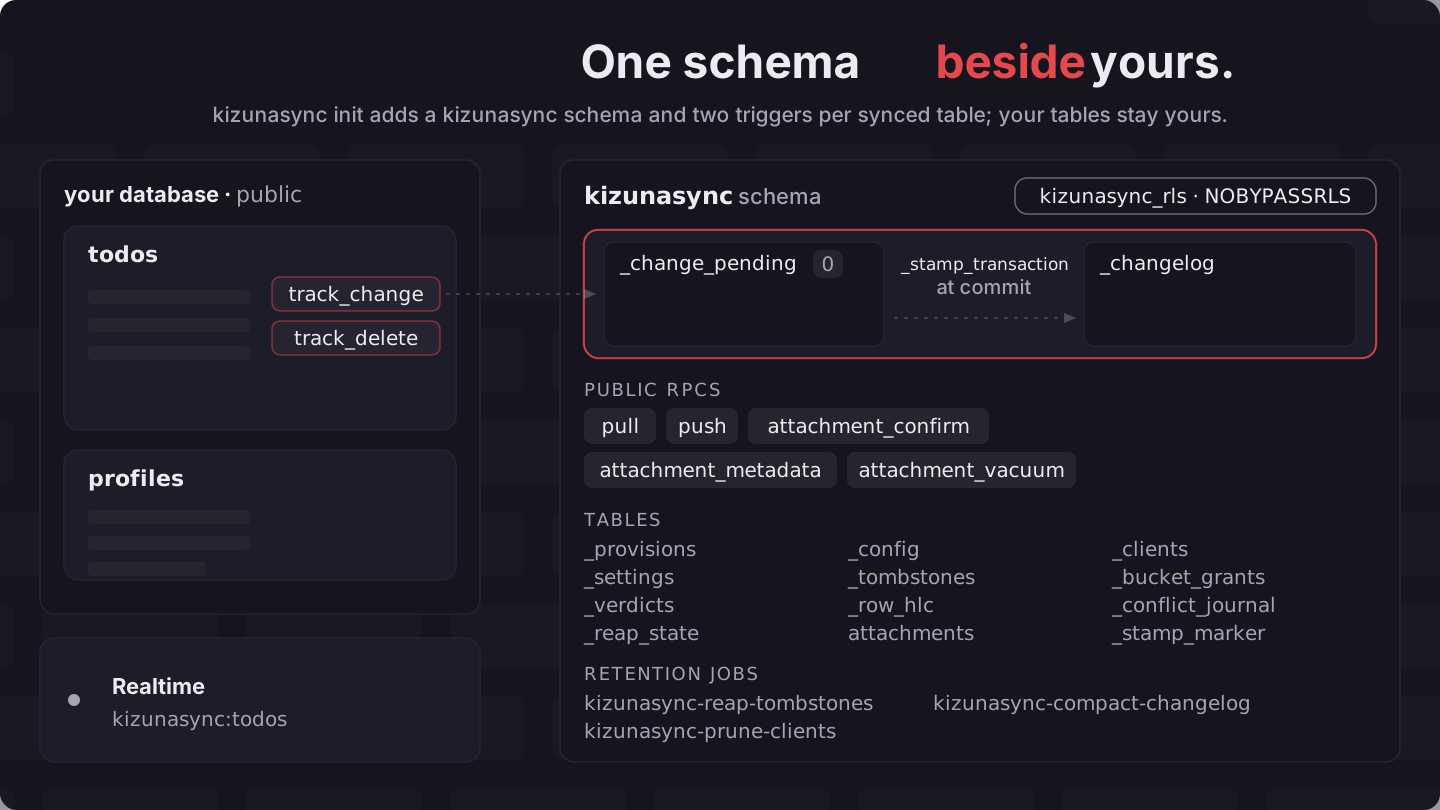
The kizunasync schema#
Kizuna keeps its engine state in the kizunasync schema, which kizunasync init also adds to the project's exposed schemas so PostgREST will serve its RPCs. The pack does not alter application tables. The generated config migration attaches two triggers to each synced table. Those triggers queue each change for the changelog and tombstone ledgers and emit wake hints. The pack writes the queued changes into those ledgers as the writing transaction commits. The triggers add no columns, constraints, indexes, or policies to your tables.
Alongside the schema the pack creates one role, kizunasync_rls, which is nologin and NOBYPASSRLS. The pack grants authenticated to that role, gives it create on the kizunasync schema, and grants the role itself to postgres. The role owns the helpers that touch application rows, so those helpers cannot bypass Row Level Security the way a table owner normally would. That is what keeps your own policies authoritative while Kizuna's bookkeeping stays private.
The internal tables#
| Table | Purpose |
|---|---|
_provisions | A partial lifecycle ledger. It records removable object rows for selected base objects and for generated per-table objects. A versioned installation may also carry pack-file rows with content hashes. The base SQL seeds object rows but no pack-file row, so kizunasync upgrade refuses that state rather than reconciling it until a later provisioning run records file-level hashes. |
_config | One row per synced table, holding its sync mode, bucket column, key columns, conflict mode, and tombstone retention. Written by kizunasync init and kizunasync sync, and read back by both. |
_clients | An optional device and session progress registry, populated only for tables with register_clients enabled and holding at most 100 registrations per user. |
_settings | The single global row: the push policy (maximum batch size, whether atomic batches are required), the pull scan cap, the three job schedules, and the client, skew, and tombstone retention knobs. |
_changelog | The append-only log of committed changes, each numbered as its transaction commits and labeled with the bucket value of the row it wrote. kizunasync.pull reads new rows from it, only the requested bucket values' rows on a bucketed table. |
_tombstones | One row per deleted record on a synced table, and per bucket value an update moved a record out of, kept until retention reaps it, which is what makes deletes win and tells a device that received a moved record from its old bucket to drop it. |
_bucket_grants | One row per user, table, and bucket value that user's pulls received a live row from. A tombstone reaches only a user who holds its pair, and a deleted row answers DELETE_WINS only to such a user. Grants are removed with their user, never by age. |
_change_pending | The queue the change-capture triggers write to inside a transaction. As the transaction commits, the pack numbers each queued change, writes it to _changelog or _tombstones, and removes it, so the table is empty outside an open transaction. |
_stamp_marker | One row per open transaction that has queued a change. Its deferred trigger numbers all of the transaction's queued changes once, at commit, and removes the row, so the table is empty outside an open transaction. |
_verdicts | The per-mutation replay ledger that stops a duplicate mutation id from being applied twice. It answers a replay only for the user who pushed the mutation, keeps no row copy, and loses entries older than client_ttl_days to prune_clients. Delivery itself stays at-least-once, as Consistency model explains. |
_row_hlc | Per-row, per-column last-writer-wins state, read only by tables whose conflict_mode is hlc. |
_conflict_journal | An optional server-side audit of overwritten column values, enabled per table by the conflict_journal column. Pull may attach matching rows as optional conflicts, and authenticated clients have no SELECT on it. |
_reap_state | A one-row watermark recording how far the tombstone retention job has reaped, which is the floor a stale cursor falls below. |
attachments | Metadata for uploaded files. The bytes live in Supabase Storage, and this table carries the reference, digest, size, media type, and the synced table whose row references the object. See Media and attachments. |
One sequence, _change_seq, supplies the changelog and tombstone ordering, and the pack draws from it only as a writing transaction commits.
The pack creates twelve indexes on those tables: _clients_user_id_idx and _clients_last_seen_idx on _clients, _changelog_seq_idx and _changelog_bucket_idx on _changelog, _tombstones_seq_idx and _tombstones_bucket_idx on _tombstones, _change_pending_row_idx on _change_pending, _conflict_journal_row_idx, _conflict_journal_winner_seq_idx, and _conflict_journal_pending_idx on _conflict_journal, _verdicts_recorded_at_idx on _verdicts, and the unique attachments_object_uidx on attachments, which is the idempotency key for the confirm call.
attachments is the one pack table with Row Level Security enabled, under three owner-scoped policies: rows are visible to their owner, insertable by their owner, and updatable by their owner. Supabase documents the mechanism in What a policy does, and these three are the only policies Kizuna writes on its own tables. The other bookkeeping tables need no policies, because authenticated holds no table privileges on them at all. Policies on the Storage objects themselves stay yours, under Storage access control.
The public RPCs#
Authenticated clients may execute exactly five functions: kizunasync.pull, kizunasync.push, kizunasync.attachment_confirm, kizunasync.attachment_metadata, and kizunasync.attachment_vacuum. They are Postgres functions reached through supabase-js rpc, and the five together are the whole public RPC surface. createRpcRemote wraps the sync pair, and createSupabaseTransfer uses the three attachment calls.
All five are SECURITY DEFINER, and they run with elevated rights only to manage Kizuna's own bookkeeping. For pull and push, application-row reads and writes are delegated to helpers owned by the NOBYPASSRLS role kizunasync_rls, so the caller's own policies decide what that caller can see or change. Supabase describes the same containment pattern in Use security definer functions, and Server-side validation states the boundary that role draws from the sync side.
The rest of the functions#
The pack creates 76 functions in the kizunasync schema. Beyond the five public RPCs they fall into five families, and none of them is executable by authenticated; five are executable by service_role as an operator surface.
| Family | Functions |
|---|---|
| Change capture | track_change, track_delete, _arm_stamp, _stamp_transaction, _seed_changelog, _relabel_changelog, _rekey_changelog, _pk_text, _pk_text_sql, _row_pk |
Maintenance and status (service_role) | reap_tombstones, compact_changelog, prune_clients, _schedule_jobs, jobs_status |
| Cursor, clock, and grammar | _clamp_hlc, _compare_hlc, _cursor_high_water, _cursor_holes, _cursor_start, _encode_cursor, _encode_continuation, _reap_horizon, _min_schema_version, _jwt_session_id, _is_cron_schedule |
| Decide and apply | _decide_mutation, _process_mutation, _apply_upsert, _apply_update_masked, _apply_increment, _apply_array_union, _apply_array_remove, _apply_transforms, _apply_delete, _apply_hlc, _rejected, _row_matches_params, _tombstone_in_buckets, _render_user_row, _render_user_row_projected, _lock_user_row, _caller_role, _readable_columns, _writable_columns, _normalize_cell, _column_write_denied, _key_columns, _key_types, _is_key_type, _pk_object, _pk_predicate, _pk_locator |
| Bookkeeping | _require_rpc_context, _lookup_verdict, _record_verdict, _record_bucket_grants, _row_hlc_lock, _row_hlc_merge, _journal_overwrites, _register_client, _conflicts_for_page, _pull_envelope, _pull_gate, _pull_horizon, _pull_candidates, _pull_page, _pull_impl, _push_guard, _is_canonical_pk, _push_impl |
The per-table hooks#
Every synced table gets two row triggers, attached by kizunasync init or kizunasync sync and never by the pack itself. kizunasync_track_change fires after an insert or update, and kizunasync_track_delete fires after a delete. Each one queues its change in _change_pending. The transaction's first queued change also fires the pack's own statement trigger on that table, kizunasync_arm_stamp, which inserts one _stamp_marker row, and as the transaction commits that row's deferred trigger, kizunasync_stamp_transaction, numbers every queued change and writes it to _changelog, or to _tombstones for a delete and for the bucket value an update moved a row out of. The two per-table triggers also send a contentless broadcast from the database on the topic kizunasync:<table>. Kizuna puts the table name in that message and never row data, so a connected client learns only that it should pull for itself.
Realtime and scheduled jobs#
The pack adds one policy outside its own schema: kizunasync wakeup receive on realtime.messages lets an authenticated client select broadcast rows on a kizunasync:% topic. Supabase calls that a broadcast read policy in Realtime authorization, and Kizuna narrows it to its own topic prefix. It changes no publication, and there is no matching send policy, because the SECURITY DEFINER trackers emit through realtime.send.
The pack tries to enable pg_cron itself, running Supabase's own documented install: create extension if not exists pg_cron with schema pg_catalog, and it grants nothing on the cron schema, because the Supabase image gives postgres what the jobs need when the extension is created. The install is guarded so it stays clean on a server that will not give it: refused or missing, the pack installs regardless. Where the extension ends up present, _schedule_jobs() schedules three jobs from _settings: kizunasync-reap-tombstones (default 16 3 * * *), kizunasync-compact-changelog (default 47 3 * * *), and kizunasync-prune-clients (default 31 3 * * *). All three functions stay callable by hand, through kizunasync jobs run, whether or not pg_cron ends up present. The config migration that init and sync generate carries its own gate ahead of the tables it provisions, and refuses to apply unless pg_cron is present or the run passed --allow-no-cron.
The provision ledger#
_provisions carries two kinds of row. Object rows are the ones teardown reads, and pack-file rows are the ones hash reconciliation reads. A pack file whose ledgered hash differs from the shipped file's is reconciled by kizunasync init's wizard or by kizunasync upgrade --reapply --yes, either of which re-applies the pack and records the shipped file's hash. A re-apply refreshes the arguments and version of each object row the pack seeds and leaves every other row in the kizunasync schema as it finds it. The ledger is deliberately partial. The base pack records its functions, the Realtime policy, the cron jobs, and the owner role. Generated per-table migrations record their triggers and config rows. Nothing records the schema itself, the bookkeeping tables, the indexes, or the sequence. All four therefore survive kizunasync deprovision. The triggers on _change_pending and _stamp_marker have no rows of their own, because dropping _arm_stamp and _stamp_transaction removes them. Remove states the same thing from the operator's side. kizunasync status and kizunasync upgrade compare the full-file hashes in pack-file rows.
Base pack rows carry pack_version 0.2.6-alpha.3, the version every workspace package shares.
Grants#
Every grant is scoped to what the client and the maintenance jobs need. Supabase treats grants and policies as two separate gates, described in Grants and policies, and Kizuna closes the grant side first. The pack never requires your service-role key, in your app, in your CI, or in the CLI itself.
| Grantee | Access |
|---|---|
authenticated | usage on the kizunasync schema; no table privileges on any bookkeeping table, including _changelog, _verdicts, and _row_hlc; select on attachments, scoped by the owner SELECT policy; execute on pull, push, attachment_confirm, attachment_metadata, and attachment_vacuum only. INSERT and UPDATE on attachments are never granted: attachment_confirm and attachment_vacuum are the writers. |
service_role | usage on the kizunasync schema; select on the bookkeeping tables for operational inspection: _changelog, _tombstones, _config, _settings, _reap_state, _clients, _provisions, _verdicts, _row_hlc, _conflict_journal, _bucket_grants, and attachments; execute on reap_tombstones(), compact_changelog(), prune_clients(), and _schedule_jobs(), which kizunasync jobs runs over a service connection, plus jobs_status(), which reads the same jobs for a Data API caller since cron itself is never exposed. |
kizunasync_rls | execute on _require_rpc_context(), plus ownership of the helpers that read and write application rows under the caller's policies. |
A client cannot write into _change_pending, _changelog, or _tombstones. The change-capture triggers are SECURITY DEFINER, and the pack grants no INSERT. A client also has no USAGE on the change sequence, and no access to _clients or _provisions. Device registration goes through the definer _register_client path inside pull and push. Most internal helpers, the apply helpers among them, require a transaction-local gate that only pull and push set. A lone Data API call to an apply helper therefore fails closed. The four maintenance functions and jobs_status refuse every claim set that is not role: service_role. SQL pack grants has the full detail.
Related pages#
Found a problem? Edit this page on GitHub